
Two routes to a metallic deposit
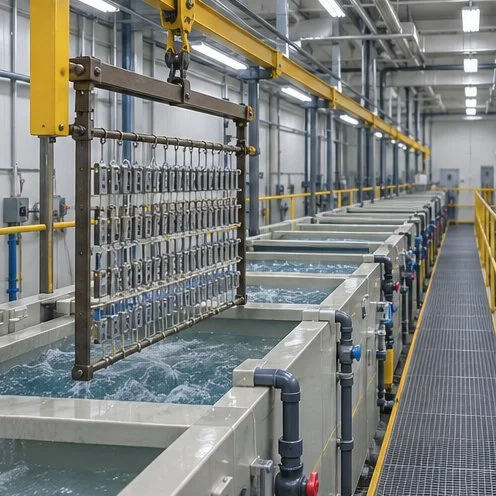
Electroplating supplies electrons from an external electrical circuit to deposit metal on a conductive workpiece. The part usually connects to the cathodic side of a rectifier, and current distribution influences where metal grows fastest. Choosing a fixture therefore means choosing both a physical support and an electrical contact arrangement.
Electroless plating uses a reducing agent in solution and a catalytic surface. In an autocatalytic process such as nickel-phosphorus deposition, the deposited material sustains the reaction once it begins under appropriate conditions. The surface still needs suitable cleaning and activation, and the bath must reach the intended features.
Electroless and immersion plating describe different mechanisms. A simple displacement coating relies on the underlying metal taking part in the reaction and typically slows once that surface is covered. Autocatalytic plating can continue to grow on the deposited layer, making it useful for engineering coatings whose thickness exceeds that of a simple displacement film.
Distribution on edges, holes and recesses
Electroplating often deposits faster on projections and slower inside recesses. Anode placement, part orientation and shielding can improve usable coverage, and certain inner surfaces may require dedicated tooling. Even when a supplier quotes a single thickness range, the drawing should identify where that range applies.
Electroless nickel can give a more even thickness over a complex shape when solution circulates freely and the surface activates consistently. Blind bores, air pockets and restrictions can still limit exchange of solution. A promising comparison on a flat coupon should be followed by measurements inside the actual features if those dimensions govern fit or wear.
For example, consider a small fluid-control housing with a bore and several exterior flats. A uniform coating may help preserve the relationship between finished diameters. The housing still needs a drainage and rinse review, and the bore may require a destructive cross-section or another qualified in-feature measurement for first-article evaluation.
Material choices and functional properties
Electroplating can apply many metals, including silver, copper, nickel and tin, for different functions. A design might use electrodeposited silver for an electrical contact while choosing a different metal for an underlying barrier. Electrical continuity, desired layer sequence and the service environment influence the overall route.
Electroless nickel-phosphorus can address wear, corrosion or dimensional needs on selected components. Deposit composition and post-deposition heat treatment influence properties, so hardness and corrosion behavior need to be specified with the intended condition in mind. ASTM B733 describes classifications and acceptance characteristics for this coating family.
A finish suitable for abrasion on a moving steel part may have little value on a soft substrate that deforms under load. Likewise, deposits selected for dimensional consistency can have limitations when the parts will be soldered, welded or exposed to specific chemicals. Evaluate the coating, base metal and later operations together.
Process controls and economics differ
An electroplating line may control current, time, solution composition, temperature and the condition of the contacts. This leaves room to adjust current distribution and fixture geometry for a particular part. Poor rack contact can create a local defect even when bath analyses and total current readings appear normal.
An electroless line requires attention to chemistry, replenishment, operating conditions and bath age. Deposition consumes the metal source and reducing chemistry as other compounds accumulate in the bath. The economics of a production run depend on loading, maintenance, chemical use and how many parts can be processed before the solution needs renewal.
Both routes require cleaning and rinsing. A compatible process may be more economical than a cheaper deposit if it reduces rejects, difficult handling or later machining. Environmental controls, inspection access and the cost of masking may also matter more than the nominal price per unit of coating metal.
Make the comparison on the part drawing
Define the base alloy and the significant surfaces, including their thickness tolerances and any restrictions on marks or buildup. Identify how much the process can change fit and whether finishing will be followed by machining, grinding or heat treatment. If two candidate finishes are expected to meet the same purpose, give both a measurable performance target.
Trial the leading candidates on representative parts, together with the proposed fixtures and inspection method. Compare process variation and appearance as well as the functional result under representative loading or exposure. Use the quality control guide to plan the measurements that will distinguish an attractive prototype from a route suitable for production.
The practical decision comes down to properties, access and process repeatability. A specified metal and the required functional region can favor electroplating, while certain complex tolerance requirements can favor an appropriately qualified electroless process. A documented trial explains why the selected route fits the component and what evidence should travel with later production lots.
Ask how the supplier will record significant process changes. A revised rack, a different chemical system or a substantial change in loading can affect results while leaving the drawing unchanged. An agreed review plan helps keep later parts comparable to the trial parts that supported the process selection.